
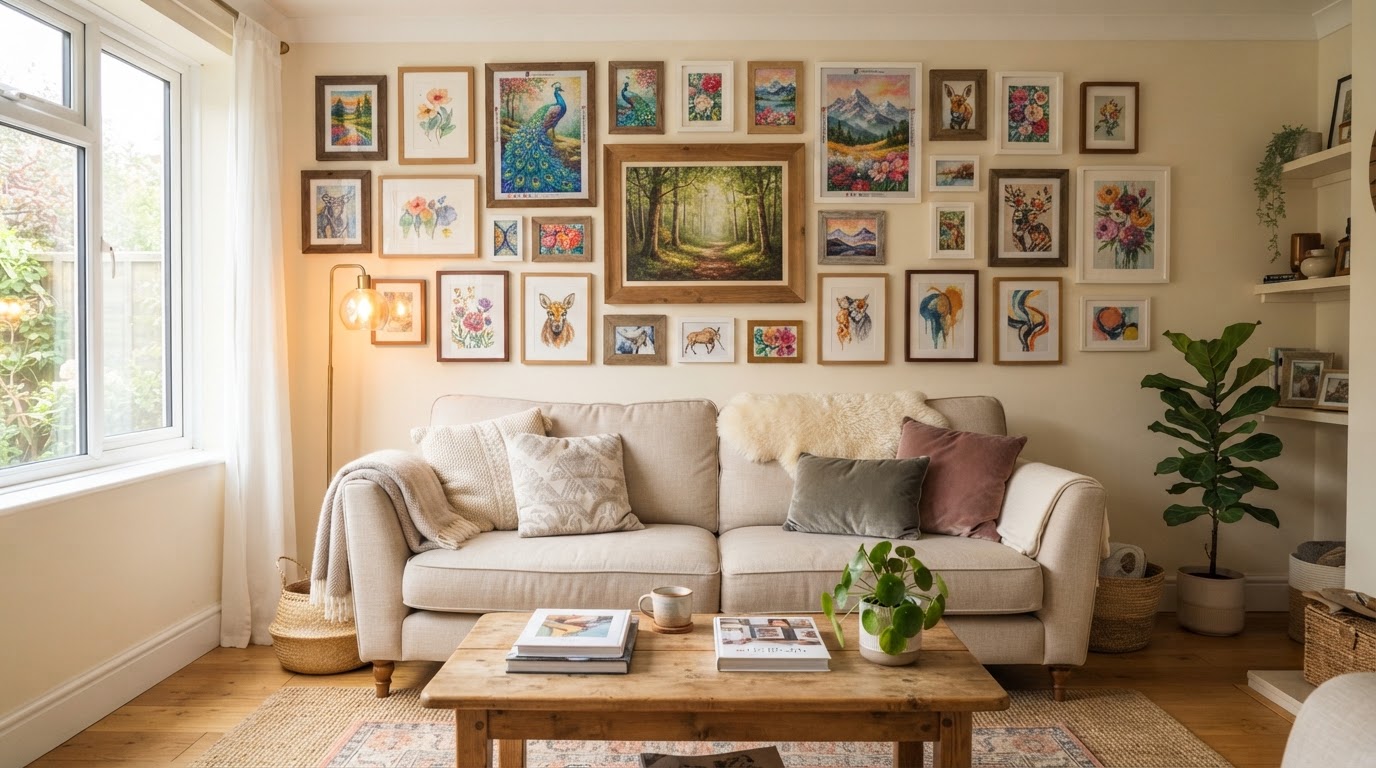
After a few finished projects, many crafters end up with paintings stacked in a cupboard. A gallery wall brings them together into one display that feels intentional and personal. Here’s how to plan and hang one.
1. Choose a wall and a theme
Living rooms above a sofa, hallways and stairwells all work well. Pick a loose theme so the wall feels cohesive: a color palette (soft florals, blues and greens), a subject (animals, landscapes) or a frame style.
2. Pick a layout
| Layout | Look | Best for |
|---|---|---|
| Grid | Neat, modern | Same-size pieces |
| Salon style | Relaxed, eclectic | Mixed sizes and frames |
| Centered anchor | Balanced | One large piece with small ones around it |
| Picture ledge | Easy to change | Rotating new projects |
3. Frame or finish each piece
Mixing frames is fine if you keep one element consistent, such as all wood or all white mats. Unframed pieces look great on stretcher bars or poster hangers. See how to frame a diamond painting, how to frame and varnish paint by numbers and displaying without a frame.
4. Plan on the floor first
Lay all the pieces on the floor and rearrange until it feels balanced. Place the largest piece first, slightly off-center, then build around it. Take a photo of the final arrangement.
5. Use paper templates
Trace each frame on kraft paper, cut it out, mark where the hook goes, and tape the templates to the wall with painter’s tape. Live with it for a day, adjust, then hang.
6. Spacing and height
- Keep 5 to 8 cm (2 to 3 in) between pieces.
- Center the whole group at about eye level, roughly 145 to 155 cm (57 to 60 in) from the floor.
- Above a sofa, leave 20 to 25 cm (8 to 10 in) between the sofa back and the lowest frame.

7. Hang securely
- Use picture hooks rated for the weight of each frame.
- Light pieces on foam board can use removable adhesive strips.
- Use a level, and add small bumper pads on the back corners to stop frames tilting.
- Keep diamond paintings out of strong direct sun.
Frequently asked questions
Can I mix diamond paintings and paint by numbers?
Yes. Matching frames or a shared color palette ties them together.
How many pieces do I need?
Three to five is enough for a small wall. You can keep adding as you finish new projects.


Leave a Reply